

ESPHome 2026.7.0: Native toolchains by default







Release Overview
Section titled “Release Overview”ESPHome 2026.7.0 flips the default ESP32 and nRF52 toolchains to native builds (ESP-IDF and the nRF Connect SDK) and lands the first coordinated wave of security infrastructure targeting EN18031 compliance: NVS encryption, OTA downgrade protection, and a new transport-agnostic provisioning component. Broad performance and memory work runs through the release, including a tree-wide single-precision float sweep across roughly 50 components, focused ESP8266 DRAM savings, ccache on by default for ESP-IDF, and shared machine-global toolchain caches.
On the feature side, the release brings a major Modbus overhaul with a rewritten parser and heap-free send path, substantial LVGL expansion (animations, dynamic rotation, boot pausing), gigabit Ethernet on the new ESP32-S31, ESP-NOW v2 payloads, RTC-backed preferences on ESP32, 11 new components covering touch controllers, e-paper panels, IMUs, and the Divoom Pixoo 64, and Zigbee endpoint merging on the new 2.0.2 SDK. The legacy Tornado web dashboard is retired in favor of the external Device Builder, and Python 3.11 support is dropped.
Upgrade Checklist
Section titled “Upgrade Checklist”- If you have an ESP32 config without an explicit
toolchain:setting, it now compiles with native ESP-IDF; addtoolchain: platformioto keep the previous behavior - If you have an nRF52 config without an explicit
toolchain:setting, it now builds with the native nRF Connect SDK; addtoolchain: platformioto keep the previous behavior - If you install ESPHome with
pipon Python 3.11, upgrade to Python 3.12 or newer - If you install ESPHome with
pipand use the built-inesphome dashboardcommand, install and runesphome-device-builderinstead - If you have ESP32 Zigbee devices, you must re-join, re-interview, and re-configure each device after upgrading
- If you set
enabledorcoordinatorunder Zigbeereporting:, remove those keys - If you use
web_server: version: 1, plan to migrate to v2 or v3 before 2027.1.0 - If you address
web_serverURLs by object ID, switch to the entity name - If a browser page hosted elsewhere calls your
web_serverendpoints, add its origin toweb_server: allowed_origins: - If you relied on
web_serverPrivate Network Access being on by default, setenable_private_network_access: trueand add the calling origins toallowed_origins: - If you use
packages: !include mypackage.yaml, wrap the include in a list:packages: [!include mypackage.yaml] - If you use
FOUR_SCAN_16PX_HIGH,FOUR_SCAN_32PX_HIGH, orFOUR_SCAN_64PX_HIGHfor hub75scan_wiring, rename toSCAN_1_4_16PX_HIGH,SCAN_1_8_32PX_HIGH, orSCAN_1_8_64PX_HIGH - If you set
disable_crcundermodbus:, remove it - If you set
send_wait_timeorturnaround_timeon amodbus:server, remove those keys - If you rely on modbus client timing, note that defaults changed to
send_wait_time: 2000msandturnaround_time: 600ms - If you use the
generic-ln882hkiboard, switch togeneric-ln882horgeneric-ln882h-tuyadepending on factory firmware - If you use the LN882H
wb02aboard withD1,D7,D8,D9, or default I2C pin aliases, update your pin numbers to match the new mapping - If you have lambdas or automations that set light brightness to
0, note that the value is now preserved instead of being clamped to1.0 - If two Home Assistant instances share the same
bluetooth_proxy, the newest subscriber now wins instead of the oldest - If you build for nRF52 boards without a DCDC regulator, DCDC settings are no longer forced and generated code changes slightly
- If your lambdas call
value_accuracy_to_string()orMideaData::to_string(), migrate to the buffer variants (value_accuracy_to_buf()andto_str(buffer))
Native Toolchains Are Now the Default on ESP32 and nRF52
Section titled “Native Toolchains Are Now the Default on ESP32 and nRF52”The default toolchain for the esp32 platform switches from PlatformIO to native ESP-IDF
(#16910). Configurations that do not set an explicit toolchain:
option will be compiled with ESP-IDF from this release forward. The framework migration notice that had been shown
since 2026.1.0 has also been removed now that the default has landed
(#17023).
The toolchain selects the build backend, not the framework: both the Arduino and ESP-IDF frameworks build on
either toolchain, with the native toolchain pulling in Arduino as an ESP-IDF component. Configurations that
explicitly set toolchain: platformio continue to build exactly as they did before, while new configurations
generated by the wizard or from packages will pick up the native ESP-IDF toolchain automatically. ESP-IDF is
now the recommended choice for both the toolchain and the framework.
The nrf52 platform makes the same move: native nRF Connect SDK builds, added earlier this cycle by
@tomaszduda23 (#16898), are
now the default toolchain (#17319). Configurations without an
explicit toolchain: option build against nRF Connect SDK 2.9.2, installed into the new shared toolchain cache
described below, and toolchain: platformio remains available as an opt-out here as well.
ESPHome Device Builder
Section titled “ESPHome Device Builder”The bundled ESPHome Device Builder has been updated, and most of the work this cycle went into the remote build server.
Compiling firmware is the slowest thing the Device Builder does, and on a small host such as a Home Assistant Green or a Raspberry Pi a single build can take several minutes. A remote build server lets that dashboard hand the compile to a faster machine on your network, such as a desktop or laptop running ESPHome Desktop, which builds the firmware and sends it back to be installed as usual. Your devices, configurations, and dashboard all stay where they are; only the build moves.
Pairing With a Build Server Is Much Easier
A machine that builds for other dashboards now says so on its own dashboard (frontend#1240). A Build server section appears above the device list once another dashboard is paired with it, or once remote building is turned on, and it walks you through pairing in three steps instead of leaving you to find the pieces in Settings.
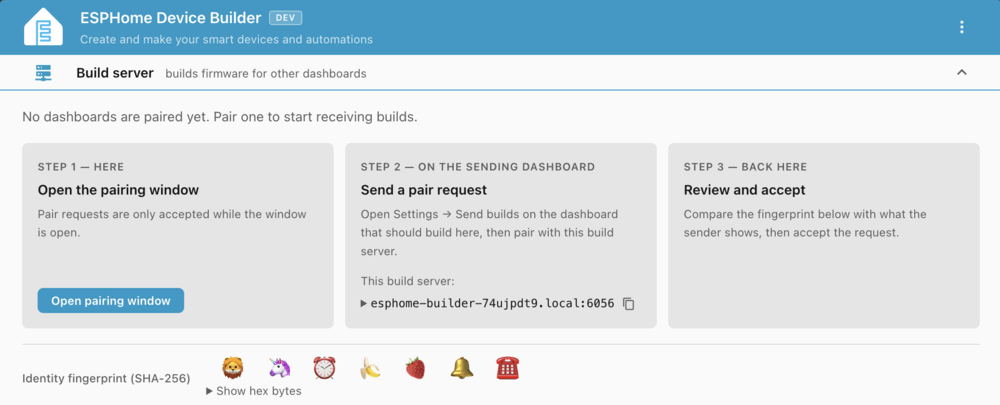
From there you can open the pairing window and watch its countdown, copy the address to enter on the sending dashboard (#2075), and compare the identity fingerprint against the one the sender shows. Once peers are paired the section lists them with their connection state and the build queue, and any pairing request waiting on you appears at the top. Settings gained a matching explainer, and the old Only use this for remote compute switch is now Remote compute dashboard, which decides which section opens first rather than hiding anything.
Remote builds are steadier once they are running, too. If a receiver restarts, the sender now reconnects as soon as it reappears on mDNS instead of waiting out its backoff (#2084). Receivers can now also provision beta versions of ESPHome, so a build server running a different version to a sender on the beta channel no longer quietly falls back to building locally (#2082). The first build for a version installs ESPHome from PyPI and can take a few minutes, which the job log now says out loud instead of sitting silent (#2083).
If you have never tried this, the terminal now shows a build timer, and a local compile that runs longer than five minutes on a dashboard with no build server paired suggests sending your builds to a faster machine (frontend#1183).
Offline and Deep Sleep Updates
Updating a device that is not awake has always been a matter of timing. An OTA aimed at a device that is asleep or otherwise unreachable simply fails, which is a familiar problem if you run anything on deep sleep.
Queued offline updates, contributed by @rwalker777, fix that (#1430, frontend#911). If a device is offline when you install to it, the Device Builder compiles the firmware, queues the update, and flashes it when the device next appears on the network, with no need for you to be watching at the time.
The groundwork for this landed in 2026.6.0, and it is ready for production use now. It works across a whole fleet: select any number of devices and hit update, and the ones that are unreachable are compiled once and queued for their next appearance rather than failing (#1929). A device that drops offline between hitting install and the build finishing is queued as well, instead of failing at the last step (#1964), and a queued update reopens as an install, carrying its queued message, when you come back to it (frontend#1181).
Quickstart Tour
Getting from a fresh install to a working device has always been the hardest part of ESPHome, and this release takes a real run at it. Setup now ends by offering you a guided tour, and the tour teaches the Device Builder by using it rather than by describing it.
It spotlights one real control at a time, explains what it is for, and on the steps that matter it waits for you to click it rather than moving on without you. Over eleven steps it walks you through creating your first device, picking a board, naming it, entering your WiFi details, finding your way around the device navigator and the editor, watching the YAML pane stay in sync as you go, and how installing to your board works, finishing on your new device sitting on the dashboard. It takes about five minutes, it leaves you with a real device rather than a throwaway, you can close it and pick it up where you left off, and it is always available afterwards from the menu in the top right.
The tour was a team effort from @Erioldoesdesign, @stvncode, and @marcelveldt, across design, wireframes, and build (frontend#1045, frontend#1232). The setup flow around it was rebuilt at the same time: a new welcome screen, an experience question that lets beginners take the recommended path with a single click, and a closing screen that hands you to the tour. If you set up the desktop app while another Device Builder is already running on your network, setup now points that out and explains how to pair the two, so you can put the new machine to work building for the dashboard you already have (frontend#1235).
YAML Errors Explained and Auto-Fixed
A number of issues reported against ESPHome turn out not to be bugs at all, but a small mistake made while editing YAML. This release goes after that whole class of problem.
Getting a space wrong used to earn you the raw parser output, mapping values are not allowed here or could not find expected ':', and only if you thought to hover over the squiggle. The line it pointed at was usually where the parser
gave up rather than where you made the mistake, which is little help if you are not already fluent in YAML.
The editor now reads the error and tells you what is actually wrong, in a banner that stays put, naming the line you
need to change and what to do to it: “Indentation mismatch: line 12 - platform is indented less than its properties.
Indent line 12 by 2 spaces so - platform lines up with them.” Next to it is a Try auto-fix button that makes
exactly that change for you. It is a best-effort guess rather than magic, so it is validated against your config before
it is applied, it tells you if other errors remain, and it lands as a normal edit you can undo
(frontend#1121,
frontend#1147,
frontend#1148).
Indentation is not the only thing it explains. Tabs used where YAML wants spaces, a value starting with @, %, or *
that needs quotes, an unterminated quote, a duplicate key, and an unclosed bracket or brace all get the same
plain-language treatment. A list marker missing its space, -platform: gpio, is offered a one-click repair to - platform: gpio (frontend#1149). So is a key that has
drifted out of the block it belongs to, such as an encryption key left sitting directly under api:, in either
direction; the Device Builder checks its component catalog first to confirm where the key really belongs, and offers
nothing rather than a wrong guess if it cannot tell
(frontend#1164).
Device log lines now link to the documentation that explains them
(frontend#1116,
frontend#1118). Ten common warnings and errors get a
curated explanation, including took a long time for an operation, WiFi reconnect loops, repeated resets, OTA
rollbacks, and running out of Bluetooth proxy connection slots, and any other line tagged with a component links
straight to that component’s page.
Headless Build Servers
@jesserockz added --remote-build-only, which runs Device Builder as a dedicated build
box with no web interface at all (#1861):
esphome-device-builder --remote-build-only /var/lib/esphome-builderIt serves only the peer link, so there is no interface for anyone to click Accept in. Instead it opens a pairing window on first start and prints its identity fingerprint and a one-time key to the console. You pair from the sending dashboard, check that the fingerprint matches the console, and type in the key, which the pair dialog knows to ask for up front (#1881, frontend#1120). That window pairs exactly one dashboard and then closes.
If you would rather keep the web interface but still dedicate the machine to building, turn on Remote compute
dashboard in Settings and a Hide the Device builder option appears beneath it, leaving only the Build server
view (#2077,
frontend#1244). Device Builder can also listen on a UNIX
socket with --socket for reverse-proxy setups, contributed by @vexofp
(#1862).
Builds
Starting a build no longer greys out the buttons that would take you back to it. Update and Install now open the running job, and Edit stays clickable so you can read your YAML while it compiles (frontend#1191, frontend#1193, frontend#1197). Download and Retry now wait for a running build to finish instead of cancelling and restarting it, which also means Download can no longer hand you a half-written binary (frontend#1199, frontend#1201, frontend#1204).
A bulk Compile only action lets you check a change across many devices before deploying any of it (frontend#1176). ESP-IDF builds now show compile progress, which is read from the ninja build counters rather than the percentage that ESP-IDF never prints (#1880).
Special thanks to @breti, whose QA testing and detailed issue reports ran through this whole release and do not show up in any pull request count.
Security and Provisioning Groundwork for EN18031
Section titled “Security and Provisioning Groundwork for EN18031”This release lands three coordinated pieces of security infrastructure, led by @kbx81, that together move ESPHome toward EN18031 compliance for network-connected consumer devices.
NVS Encryption on ESP32 (#17004)
Opt-in encryption for Non-Volatile Storage using the HMAC peripheral. Keys are derived at runtime from an HMAC key in a user-selected eFuse block, so flash encryption is not required. Supported on the ESP32 variants that ship the HMAC peripheral: S2, S3, C3, C5, C6, H2, and P4. Burning the HMAC key to an eFuse block is a permanent, irreversible operation, so users should read the esp32 documentation carefully before enabling this.
OTA Downgrade Protection (#17315)
Software anti-rollback for signed ESP-IDF OTAs. The version baked into the staged image (from
project: version:) is compared against the running version before the boot partition is switched. Covers all OTA
sources: native, http_request.ota, and web_server. Requires a signed OTA to be effective.
Provisioning Component (#17152)
A new transport-agnostic provisioning component that manages a provisioning window for
devices shipping unprovisioned. Sources such as api and esp32_improv register with the component, and the
window is closed on timeout, at which point any provisioning-related API clients are disconnected with
DISCONNECT_REASON_PROVISIONING_CLOSED.
Performance: Single-Precision Float Math
Section titled “Performance: Single-Precision Float Math”Led by @swoboda1337, a tree-wide sweep replaces silent
double-promotion patterns with single-precision equivalents across roughly 50 components
(#17252,
#17253,
#17254,
#17255,
#17256,
#17260).
The issue was invisible on ESP32 because ESP-IDF does not enable -Wdouble-promotion: literals like 2.0 and
functions like fmod, round, and fabs were quietly promoting single-precision values to double, running the
result through the soft-double library on chips without hardware doubles, then narrowing back to float.
Measured Impact:
hsv_to_rgbcode size: 108 bytes → 69 bytes (-36%) on ESP32- Soft-double helper calls eliminated: roughly 8 per call site
- Components touched: displays, lights, climate, most sensor drivers,
openthread,mqtt,speaker,graph, and many more
The final straggler pass (#17260) also rewrites hot expressions
such as std::pow(2, sf) in sx126x to a constexpr bit shift, and switches a few call sites
to std::numbers::pi_v<float>.
Memory: ESP8266 DRAM Savings
Section titled “Memory: ESP8266 DRAM Savings”Every byte of RAM matters on ESP8266, and three focused changes by @bdraco reclaim a useful chunk of DRAM without changing runtime behavior.
- libstdc++ throw message strings (#17341) — Overrides
std::__throw_*helpers so the never-read message arguments are dropped. Saves roughly 96 bytes of RAM on a ratgdo build. Crash behavior is unchanged. - lwIP glue DHCP stub strings (#17395) — Silent equivalents
for
dhcp_cleanup()anddhcp_release()stubs. Frees48bytes of RAM and88bytes of flash, and removes the noisySTUB: dhcp_cleanuplog on every WiFi disconnect. - dashboard_import package URL (#17127) — Moves the mDNS TXT
package_import_urlstring from.rodata(DRAM) to flash. It was the last mDNS TXT value pinned in RAM.
Build System: ccache and Shared Toolchain Caches
Section titled “Build System: ccache and Shared Toolchain Caches”Led by @swoboda1337, the ESP-IDF and nRF SDK toolchains gain both compiler-level caching and installation-level sharing.
ccache is now on by default for ESP-IDF builds (#17163,
#17136) when the ccache binary is present, using depend mode
(depfile hashing instead of preprocessing) and a cache directory under the IDF tools path. Opt out with
IDF_CCACHE_ENABLE=0. On the 23-batch CI matrix, summed runner time dropped from 543 to 504 minutes (~7%) and
wall time from 154 to 139 minutes.
Toolchains now install into a machine-global cache directory
(#17306,
#17353). ESP-IDF installs to
~/.cache/esphome/idf and the nRF Connect SDK installs to ~/.cache/esphome/sdk-nrf, so multi-gigabyte toolchain
installs are shared across every project on the machine instead of being duplicated per config. Docker and Home
Assistant add-on users pin these to persistent volumes, and existing installs re-download once after upgrade.
Config validation got faster too, thanks to import deferral by @frenck:
aioesphomeapi.posix_tz deferral cuts esphome config median wall time by roughly 33% on a host config from
445 ms to 297 ms (#17214), and deferring requests imports
shaves another ~70 ms (~16%) (#17215).
Component Alias Infrastructure
Section titled “Component Alias Infrastructure”A new core mechanism (#16826) lets components be renamed without
breaking existing YAML configurations. Components declare ALIASES = [...] (and an optional
ALIAS_REMOVAL_VERSION), and a pre-pass in config validation rewrites legacy keys while a sys.meta_path finder
resolves Python imports for esphome.components.<oldname>. Aliases are discovered by an AST scan so components do
not need to be imported to enumerate them.
The first user of the new infrastructure is the rp2 rename
(#17145) by @jesserockz, which
renames the rp2040 platform to rp2 to reflect its coverage of both RP2040 and RP2350. The legacy rp2040:
YAML key and esphome.components.rp2040 imports continue to work as deprecated aliases and will be removed in
2027.7.0. New rp2_2040 and rp2_2350 variant kwargs are added to SplitDefault and
require_framework_version, mirroring the ESP32 pattern.
Modbus Overhaul
Section titled “Modbus Overhaul”@exciton landed a major rework of the modbus component across multiple PRs.
Client and server split (#11969) — Modbus is split into
ModbusClientHub and ModbusServerHub, retiring the role enum entirely. Client components move to
ModbusClientDevice (#11987), and the core API surface was
renamed and settled before the release (#17434,
#17378). External components need to update against the new
API now, and further client-mode API cleanup is planned for the next release.
Rewritten parser — Byte-by-byte parsing is replaced with a buffer-based, frame-length-aware parser that
handles peer server responses, unsupported function codes, and custom function codes correctly. Response tracking
uses std::optional<ModbusDeviceCommand>, enabling address+function-code matching, multiple devices per address,
and two new callbacks: on_modbus_no_response() and on_modbus_not_sent().
Heap-free send path — A new SmallInlineBuffer<8> and StaticVector<uint8_t, MAX_PDU_SIZE> mean that 8-byte
Modbus frames (the common case for reads and single-register writes) live inline in the deque node with zero
per-frame heap activity (#17282).
Server improvements (#17205) — Multi-register values now
match by full span, a new allow_partial_read option is available, overlapping registers are rejected, and the
obsolete RAW value type has been removed from server mode.
Default send_wait_time moves from 250ms to 2000ms and turnaround_time from 100ms to 600ms. If you were
overriding these to compensate for the old parser, review whether the overrides are still needed.
LVGL: Animations, Rotation, and Runtime Updates
Section titled “LVGL: Animations, Rotation, and Runtime Updates”@clydebarrow drove a substantial expansion of the lvgl component this release.
- Animations (#16796) — Full LVGL animation support with
from/to interpolation, timing functions (gravity and friends), duration, looping, and
auto_start. - Dynamic rotation (#16773) — Templated
lvgl.display.set_rotationin degrees, newon_landscapeandon_portraittriggers, and layout option updates inlvgl.update. - Direct
mappingsyntax (#15863) — Cleaner LVGL text and imagesrcupdates using a mapping directly. - Boot pausing (#16973) — A new
pausedconfig option suppresses LVGL updates on boot. Especially useful for e-paper displays that should not render invalid state before the API connects. - Continued activity while display busy (#17374) — When
update_when_display_idleis used (typical for e-paper), LVGL now still processes user input and runs timers while the display refresh is in progress. The LVGL refresh interval, previously fixed at 16 ms, is now configurable.
Networking and Connectivity
Section titled “Networking and Connectivity”Gigabit Ethernet on ESP32-S31 (#17277) — Adds
type: GENERIC and type: YT8531 PHYs for the new RGMII-capable ESP32-S31 variant, which requires ESP-IDF 6.1.
The YT8531 handler covers auto-negotiation re-enable and RGMII Tx/Rx delays. New power_pin and phy_registers
options are available on the ethernet component.
ESP-NOW v2 payloads (#17360) — The
espnow component gains a max_payload_size option that accepts frames up to 1470 bytes
(previously capped at 250). The default stays at 250; going to 1470 costs roughly 44 KB of RAM versus about 8 KB
at the default. Requires ESP-IDF ≥ 5.4 or Arduino ≥ 3.2.
LN882X MQTT support (#17297) — LN882H boards can finally use the mqtt component. LN882X was previously blocked despite sharing the LibreTiny backend.
Data whitening for SX126x (#17102) — Configurable FSK data
whitening (CCITT algorithm) via new whitening_enable and whitening_initial options.
Bluetooth proxy subscriber semantics (#17423) — A later subscriber now takes over the single subscriber slot from a stale one instead of being silently rejected. This fixes the “connected but no advertisements” state that could occur after a Home Assistant restart within the ~150 second keepalive window. Users don’t need to change configs, but the observed behavior does change.
OpenThread on Zephyr/nRF52 and MTD Polling Control
Section titled “OpenThread on Zephyr/nRF52 and MTD Polling Control”Basic Zephyr/nRF52 support (#16854) — First-cut openthread support on the nRF52 Zephyr platform, by @Ardumine. Handles the “join network” flow.
Runtime poll period control (#11766) — A new
set_poll_period action lets a Minimal Thread Device (Sleepy End Device) temporarily switch to radio-always-on
for OTA. http_request.ota becomes roughly 10x faster on MTDs, and esphome.ota starts working at all.
RTC-Backed Preferences on ESP32
Section titled “RTC-Backed Preferences on ESP32”@bootc taught the ESP32 preferences backend to honor the in_flash=false flag of
make_preference() (#17073), adding RTC-memory-backed preferences
in the same way ESP8266 already had them. The shared word-buffer plus checksum format is extracted into
preferences_rtc.h.
New configuration surface:
safe_mode: storage: rtcorflashwifi: fast_connect:dict form withenabledandstoragesub-optionspreferences: rtc_storage: true
The ESP32-C2 and ESP32-C61 have no RTC RAM and fall back gracefully. This is groundwork for a planned DHCP-lease cache and was validated across ESP32 PICO, S3, C3, and C6 hardware.
New Displays, Touch Controllers, and Peripherals
Section titled “New Displays, Touch Controllers, and Peripherals”The release adds broad support for new display and touch hardware, largely on M5Stack, Waveshare, and Seeed reTerminal families.
Touch controllers — cst328 by @latonita (#8011), st7123 integrated display-touch driver for the M5Stack Tab5 by @miniskipper (#12075), gsl3670 for Seeed reTerminal D1001 by @clydebarrow (#16285), and cst9220 covering CST9220 and CST9217 by @clydebarrow (#16888).
E-paper displays — The epaper_spi component picks up several new panels: Waveshare 7.5” V2 BWR 800×480 by @twisterss (#15719), Seeed reTerminal E1004 13.3” 6-color (T133A01, dual-CS SPI) by @limengdu (#16706), Waveshare 2.13” V4 BWR (SSD1683) by @profplump (#16828), Soldered Inkplate 2 by @arunderwood (#16856), and Seeed reTerminal-sticky by @clydebarrow (#16950). The it8951 e-paper controller for M5Paper and Seeed reTerminal E1003/EE03 (up to 1872×1404, 16-level grayscale) arrives as a new component by @Passific (#15346).
MIPI-SPI displays — M5STACK ATOM3SR by @clydebarrow (#17344) and the Waveshare ESP32-S3-Touch-AMOLED-1.64 (SH8601) by @crimike (#17386).
Divoom Pixoo 64 — A new pixoo component by @jesserockz (#16974) drives the 64×64 RGB LED matrix over SPI and exposes a light platform for panel brightness alongside the image API.
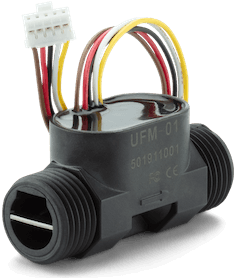
Sensors and peripherals — A ufm01 ScioSense UFM-01 ultrasonic flow meter by @ljungqvist (#16582) reports accumulated flow, flow rate, water temperature, and four diagnostic binary sensors over UART. A qmi8658 6-axis IMU by @clydebarrow (#16889) adds accelerometer, gyroscope, and on-chip temperature sensing with a motion platform. The waveshare_io_ch32v003 I/O expander by @latonita (#10071) covers the CH32V003-based expander shipped on Waveshare’s newer S3 boards, providing EXIO GPIO, PWM backlight control, an ADC battery voltage sensor, and RTC interrupt status.
Audio — The pcm5122 component grows analog gain (0/-6 dB), channel mixing
(stereo/left/right/swapped), configurable volume range, a standby/powerdown switch, and an XSMT enable pin, along
with a fix for a clock register page bug that had been silently corrupting clock setup
(#17313) by @remcom. The
i2s_audio speaker now accepts wider streams (e.g. 24-bit into a 16-bit device) and
narrows them in place using esp-audio-libs’ pcm_convert::copy_frames
(#16821).
Image Component Becomes a Platform
Section titled “Image Component Becomes a Platform”@jesserockz restructured image: into a platform component
(#17416). The new form uses platform: file,
platform: animation, and platform: online_image, with animation becoming a proper sub-component of the
new file platform. The legacy top-level image:, animation:, and online_image: keys continue to work through
2027.1.0 with copy-paste migration warnings shown at validation time.
Zigbee: SDK 2.0.2 and Endpoint Merging
Section titled “Zigbee: SDK 2.0.2 and Endpoint Merging”@luar123 bumped the zigbee component on ESP32 to the new esp-zigbee-sdk 2.0.2 for better ESP-IDF compatibility and picked up ESP32-H4, H21, and S31 variants (#16869). The dedicated Zigbee storage partition has been retired in favor of the default NVS, and reporting configuration is simplified: the enabled/coordinator distinction is gone.
A follow-up (#17402) merges endpoints of components on ESP32 and lets users manually combine them. This enables single-endpoint devices with multiple sensors, matching Zigbee standard expectations. Both PRs require existing Zigbee devices to be re-joined, re-interviewed, and reconfigured after upgrading.
YAML Merge Warnings
Section titled “YAML Merge Warnings”@clydebarrow added a warning when a YAML merge (<<:) silently drops a key
(#17246). Two top-level api: blocks combined via <<: would
previously drop one without any indication; ESPHome now prints the source location, explains that a merge is
happening, and suggests packages: for a deep merge instead. Toggle with esphome: merge_warnings: false.
Other Notable Features
Section titled “Other Notable Features”- Legacy web dashboard removed (#17124) — The built-in
Tornado-based dashboard is gone in favor of the external ESPHome Device Builder. The
dashboardCLI command remains but is hidden and prints a migration hint. Docker and Home Assistant add-on users are unaffected: they already route to Device Builder. - Python 3.11 support dropped (#17280) — Minimum Python version is now 3.12. Home Assistant add-on and Docker images are already on 3.12.
- BK7238 and Tuya T1 board support (#17288) — The
LibreTiny 1.13.0 update adds BK7238 boards to the
bk72xxplatform:generic-bk7238,generic-bk7238-tuya, and the Tuya T1 module family (t1-2s,t1-3s,t1-m,t1-u), which is becoming common in devices on the market. - PSRAM for ESP32-S31 and H4 (#17192) — Both new variants
gain PSRAM wiring: S31 octal at 40/100/200/250 MHz and H4 quad at 32/64 MHz. Values come from the
esp_psramKconfig on ESP-IDF release/v6.1, and octal-mode validation is now data-driven rather than hardcoded to S3. - Host platform preferences directory (#11160) — A new
ESPHOME_PREFDIRenvironment variable overrides where the host platform stores preferences, useful when running ESPHome as a system service whereHOMEmay not be set. - Web server SSE optimization (#17400) — Logger’s known
message length is now threaded through the SSE send path, avoiding
strlenandstrchrrescans on every log event. No wire changes. - Web server HTTP digest authentication (#17541) —
web_serverauth:gains a newtype:option to selectbasicordigest. Digest keeps the password off the network (only hashes are sent) instead of the trivially reversible Base64 that Basic uses; both look identical in the browser. The scheme is fixed at build time so the unused code path is compiled out. The default staysbasicfor now to avoid breaking non-browser REST clients and will change todigestin 2027.1.0; settype: basicexplicitly to keep the current behavior after that release. - WiFi roaming scan suppression (#17012) — A new internal API lets components request that post-connect roaming scans be paused. First user is sendspin, which now suppresses roaming scans while playing to prevent audible hiccups (#17133).
- Runtime UART reconfiguration (#16990) — Baud rate, parity, and other UART settings can now be changed at runtime on open channels without reconnecting. Landed for both the standard uart and usb_uart components.
- Light brightness on turn-off preservation (#17103) — Setting brightness to 0 no longer silently clamps to 1.0. If a subsequent turn-on has no explicit brightness and the current brightness is 0, brightness is set to 1.0 at turn-on time instead.
- coex/sdkconfig reconciler (#17008) — A single reconciler
now handles WiFi/Ethernet/BLE coexistence sdkconfig flags on ESP32, killing conflicting values (for example
ethernetversusesp32_ble_trackeronCONFIG_SW_COEXIST_ENABLE). Behavior is preserved and internal helpers gain semantic names such asrequest_wifi,request_ethernet, andrequest_software_coexistence. - Visual editor visibility hints (#17449) — Build-system and
framework internals are now marked with
cv.Visibilityso the Device Builder visual editor can hide them from users who edit YAML from the browser.
Thank You, Contributors
Section titled “Thank You, Contributors”This release includes 217 pull requests from over 30 contributors. A huge thank you to everyone who made 2026.7.0 possible:
- @swoboda1337 - 45 PRs including making ESP-IDF the default esp32 toolchain, the tree-wide single-precision float math sweep, wiring up ESP32-S31/H4/H21 support, ccache and shared toolchain caches, gigabit ethernet, ESP-NOW v2 payloads, and dropping Python 3.11
- @jesserockz - 45 PRs including the generic component alias infrastructure,
the
finalclass sweep across 21 batches, the [pixoo] Divoom Pixoo display component, the [rp2] platform rename, the [image] platform restructure, and removing the legacy web dashboard - @clydebarrow - 17 PRs including LVGL animations, dynamic rotation, boot pausing and continued-activity-while-display-busy, the new [gsl3670] and [cst9220] touchscreens, the [qmi8658] IMU motion platform, the [mipi_spi] M5STACK ATOM3SR, YAML merge-drop warnings, and preserving light brightness on turn-off
- @exciton - 9 PRs including the major [modbus] parser rewrite and client/server hub split, heap-free send path, register-range fixes with partial reads, and the finalized API surface
- @tomaszduda23 - 8 PRs building out native nRF52 builds: native SDK support, upload flow, config-input rebuild triggers, non-nRF52840 board support, libc selection, and OTA error reporting
- @kahrendt - 6 PRs including WiFi roaming-scan suppression, the [sendspin] playback integration, [i2s_audio] stream narrowing, and microMP3 bumps
- @Ardumine - 5 PRs extending nRF52/Zephyr networking: BSD socket support, basic OpenThread, mDNS, [api] support, and enlarged Zephyr net buffers
- @kbx81 - 4 PRs including ESP32 NVS encryption, OTA downgrade protection, the new [provisioning] component, and the ESP32 network/coexistence sdkconfig reconciler
- @p1ngb4ck - 4 PRs including [usb_uart] per-device baud caps, FTDI RX
stability fixes, and a vector
pop_backhelper - @luar123 - 3 PRs including the [zigbee] SDK 2.0.2 bump and endpoint merging on esp32
- @frenck - 3 PRs deferring
aioesphomeapiandrequestsimports to speed up config validation, and refining ESP32-S3 PSRAM pin warnings - @latonita - 2 PRs including the new [cst328] touchscreen and the [waveshare_io_ch32v003] I/O expander
- @rwrozelle - 2 PRs including the [openthread]
set_poll_periodaction for MTDs and a [socket] wake-request gate fix - @anunayk - 2 PRs including Zephyr GPIO interrupts and [ble_nus] atomic log framing
- @remcom - 2 PRs including the [pcm5122] analog gain, channel mixing, and standby/powerdown work, plus [audio_file] MP3 detection fixes
- @miniskipper - the new [st7123] touch controller component for the M5Stack Tab5
- @Passific - the new [it8951] e-paper controller component
- @ljungqvist - the new [ufm01] ultrasonic flow meter component
- @bootc - RTC-backed preferences on ESP32, honoring the
in_flashflag
Also thank you to @bdraco, @haku, @Eelviny, @twisterss, @ddrown, @limengdu, @profplump, @arunderwood, @kyvaith, @jspiros, @guillempages, @zeroflow, @mikelawrence, @jclehner, @berikv, @Bl00d-B0b, and @crimike for their contributions, and to everyone who reported issues, tested pre-releases, and helped in the community.
Breaking Changes
Section titled “Breaking Changes”Platform Changes
Section titled “Platform Changes”- ESP32: ESP-IDF is now the default toolchain when no explicit
toolchain:is set. Addtoolchain: platformioto youresp32:block to keep building with PlatformIO #16910 - Python: Minimum supported Python bumped to 3.12. Home Assistant add-on and Docker are unaffected; only
direct
pipinstalls on 3.11 need to upgrade #17280 - nRF52: The native nRF Connect SDK toolchain is now the default when no explicit
toolchain:is set. Addtoolchain: platformioto yournrf52:block to keep building with PlatformIO #17319 - nRF52: The Zephyr DCDC settings are no longer forced by ESPHome, which slightly changes generated code depending on board settings and allows building for boards without DCDC #17373
Dashboard
Section titled “Dashboard”- Legacy Dashboard: The built-in Tornado web dashboard has been removed. Users installing via
pipshould install and run esphome-device-builder instead. Docker and Home Assistant add-on users are unaffected #17124
Component Changes
Section titled “Component Changes”- Bluetooth Proxy: The newest advertisement subscriber now takes over the single subscriber slot from a stale one instead of being rejected. Fixes “connected but no advertisements” after a Home Assistant restart within the ~150 second keepalive window #17423
- Hub75: The deprecated
scan_wiringnamesFOUR_SCAN_16PX_HIGH,FOUR_SCAN_32PX_HIGH, andFOUR_SCAN_64PX_HIGHhave been removed. UseSCAN_1_4_16PX_HIGH,SCAN_1_8_32PX_HIGH, andSCAN_1_8_64PX_HIGHinstead #17118 - Light: Setting brightness to
0no longer silently clamps to1.0. If a subsequent turn-on has no explicit brightness and the current brightness is0, brightness is restored to1.0at turn-on time instead #17103 - LibreTiny (LN882H):
generic-ln882hkiboard removed; usegeneric-ln882horgeneric-ln882h-tuyadepending on factory firmware. Default LN882H log UART is nowUART1. LN882H partition layouts changed (on-device OTA migration handled by LibreTiny). On thewb02aboard, pin aliases shifted (D1→ GPIO6,D7→ GPIO5,D8→ GPIO9,D9→ GPIO24, newD10→ GPIO25) and default I2C pin order changed #17288 - Modbus: The
disable_crcoption has been removed, along withsend_wait_timeandturnaround_timefrom server mode. Client-mode defaults were raised:send_wait_time250ms → 2000ms,turnaround_time100ms → 600ms #11969 - Packages: The single-package
!includeform is removed. Wrap the include in a list:packages: [!include mypackage.yaml]#17119 - Web Server: The deprecated object ID URL matching fallback has been removed. URLs are matched by entity name only #17113
- Web Server: Version 1 is deprecated. A configuration warning is emitted when
version: 1is set; removal is targeted for 2027.1.0. Migrate to v2 (the default) or v3 #17109 - Web Server: Cross-origin browser requests carrying an
Originheader are now rejected unless the origin matches the requestHost(same-origin) or is listed in the newallowed_origins:option. Requests with noOriginheader (curl, native API, other non-browser clients) are always allowed, so this is defense-in-depth against the browser confused-deputy/CSRF case, not an authentication boundary. Private Network Access is now off by default (previously on) and, when enabled, reusesallowed_origins:to authorize preflights; enabling PNA without any allowed origins is rejected at config validation #17530 - Zigbee: The Zigbee SDK bump to 2.0.2 changes the storage layout, so ESP32 devices must be re-joined and
reconfigured after upgrading. The
reporting:config valuesenabledandcoordinatorare no longer valid #16869 - Zigbee: on ESP32 endpoint merging now combines endpoints of components by default and lets users manually combine them. Existing configurations require re-joining, re-interviewing, and re-configuring #17402
- Display Components: The MIPI family of display drivers (
mipi_spi,mipi_dsiandmipi_rgb) now enforce configuration of mandatory components such as PSRAM and I/O expanders where required. This applies only to those display models that identify integrated boards with known hardware assignments. #17405
Undocumented API Changes
Section titled “Undocumented API Changes”Users with lambdas that call internal string-formatting helpers should note the following removals. Both
methods were deprecated 6 months ago in favor of buffer-based variants that avoid std::string allocation.
-
Core:
value_accuracy_to_string()has been removed. Usevalue_accuracy_to_buf(), which writes into a caller-provided buffer ofVALUE_ACCURACY_MAX_LENbytes. #17116Before:
std::string s = value_accuracy_to_string(value, accuracy);After:
char buf[VALUE_ACCURACY_MAX_LEN];value_accuracy_to_buf(buf, value, accuracy); -
Remote Base (Midea):
MideaData::to_string()has been removed. Useto_str(buffer)instead, which formats into a caller-provided buffer. #17117Before:
std::string s = data.to_string();After:
char buf[32];data.to_str(buf); -
Dashboard Import (ESP8266):
package_import_urlis now stored as a PROGMEM flash literal (ProgmemStr) rather than a plainconst char *in DRAM. Existing consumers already read it as a flash pointer (mDNS viaMDNS_STR_ARG, MQTT via ArduinoJson’s__FlashStringHelperoverload), so this is a transparent change on ESP8266 and a no-op on other platforms. Lambdas that readpackage_import_urlon ESP8266 should not dereference it as a plainconst char *. #17127
Breaking Changes for Developers
Section titled “Breaking Changes for Developers”- Modbus API split:
Modbusis split intoModbusClientHubandModbusServerHub;ModbusDevice::set_parent()now takesModbusClientHub *;Modbus::register_device()removed (#11969, #11987, #12376) - Modbus API naming: Core public API surface renamed and settled before release; further client-mode API cleanup is planned for the next release (#17378, #17434)
- Modbus function code comparisons: Ordering operators (
<,<=,>,>=) betweenModbusFunctionCodeanduint8_tremoved. Cast explicitly or usehelpers::is_function_code_*()#11969 - Select
statemember removed: Usecurrent_option()oractive_index()instead #17027 - Scheduler
std::stringoverloads removed:App.scheduler.set_timeout(std::string, ...)and relatedstd::string-name overloads are gone; passconst char *names #17111 get_object_id()andget_compilation_time()removed: Previously deprecated core helpers deleted #17112GPIOPin::dump_summary()returningstd::stringremoved: Overrides must return via the buffer form #17115- UART
load_settings(bool)is now pure virtual: AllUARTComponentsubclasses must implement runtime settings updates #16990 - API pre-1.14 object_id backward-compat removed: Old client fallback path deleted #17108
- Preferences RTC helpers moved: Word-buffer + checksum format extracted to
preferences_rtc.hand shared between ESP32/ESP8266 #17073 - Network
use_addresslogging changes: Runtime MAC-suffix expansion moved into the network component #17432 - Configurable classes marked
final: Roughly 20 batches of components addfinalto their runtime-instantiated concrete classes to allow devirtualization (#16952-#16972, #17129, #17130, #17147) rp2040component renamed torp2: Python importsesphome.components.rp2040and therp2040:YAML key continue to work as deprecated aliases through 2027.7.0 via the new alias infrastructure (#17145, #16826)mipi_display driver model config changes: Use ofswap_xy=cv.UNDEFINEDin a model definition is deprecated. #17405
For detailed migration guides and API documentation, see the ESPHome Developers Documentation.
Release 2026.7.1 - July 21
Section titled “Release 2026.7.1 - July 21”- [emc2101] Fix negative external temperatures reported as large positives esphome#17494 by @swoboda1337
- [haier] Fix outdoor defrost temperature reporting the coil temperature esphome#17492 by @swoboda1337
- [zephyr] implement ISRInternalGPIOPin::digital_write esphome#17601 by @quantum5
- [as3935_i2c] Use repeated start when reading registers esphome#17584 by @swoboda1337
- [micro_wake_word] Include the local model file in bundles esphome#17604 by @bdraco
- [core] Improve framework mirror selection, download errors, and version parsing esphome#17615 by @swoboda1337
- [http_request] Fix use-after-return of header collection state in IDF backend esphome#17627 by @swoboda1337
- [web_server_idf] Use core format_hex_to helper for digest auth (fixes Arduino build) esphome#17608 by @swoboda1337
- [nrf52] Set ZEPHYR_SDK_INSTALL_DIR for Zephyr SDK discovery esphome#17633 by @jesserockz
- Bump bundled esphome-device-builder to 1.6.2 esphome#17640 by @esphome[bot]
- Bump aioesphomeapi from 45.6.0 to 45.6.1 esphome#17653 by @dependabot[bot]
- Bump aioesphomeapi from 45.6.1 to 45.6.2 esphome#17654 by @dependabot[bot]
- Bump bundled esphome-device-builder to 1.6.3 esphome#17651 by @esphome[bot]
- [espidf] Suggest installing missing system libraries when the tools install fails esphome#17619 by @swoboda1337
- [core] Fix srcFilter exclusions being silently ignored on Windows esphome#17648 by @bharvey88
- Pin cryptography to 48.0.1 on Intel macOS esphome#17658 by @bdraco
- Ship component requirements.txt files in the sdist and wheel esphome#17660 by @bdraco
- [logs] Cap the logs reconnect backoff for deep-sleep devices esphome#17656 by @bdraco
- [nrf52] Install PlatformIO toolchain Python packages into a dedicated venv esphome#17635 by @jesserockz
- Bump bundled esphome-device-builder to 1.6.4 esphome#17662 by @esphome[bot]
- [esp32] Bump recommended ESP-IDF to 5.5.5 and Arduino to 3.3.10 esphome#17669 by @swoboda1337
- Bump bundled esphome-device-builder to 1.6.5 esphome#17675 by @esphome[bot]
- Bump bundled esphome-device-builder to 1.6.6 esphome#17681 by @esphome[bot]
- Bump bundled esphome-device-builder to 1.6.7 esphome#17696 by @esphome[bot]
- Split multi-token build.flags entries when generating ESP-IDF component CMakeLists esphome#17649 by @bharvey88
- [ssd1306] Fix offset_x being ignored on SH1106/SH1107 displays esphome#17700 by @jesserockz
- [micro_wake_word] Download models in parallel esphome#17701 by @bdraco
- [platformio] Accept git URLs passed as the library name esphome#17697 by @bdraco
- [git] Detect interrupted clones and re-clone automatically esphome#17690 by @bdraco
- [espidf] Make openocd-esp32 optional so its libusb check cannot break installs esphome#17686 by @bdraco
- [light] Fix pulse and other effects esphome#17645 by @clydebarrow
- Bump bundled esphome-device-builder to 1.6.8 esphome#17708 by @esphome[bot]
- [core] Auto-clean the PlatformIO build environment when the Python version changes esphome#17671 by @bdraco
- [platformio] Re-download library when cached copy is missing its manifest esphome#17691 by @bdraco
- [http_request] Fix usage of http response body esphome#17713 by @kamaradclimber
- [platformio] Include cache path in invalid library error esphome#17692 by @bdraco
- [espidf] Resume interrupted toolchain downloads instead of restarting esphome#17706 by @bdraco
- [wireguard] Mark private keys sensitive, stop redacting public keys esphome#17736 by @bdraco
- [esp8266] Fail fast when Rosetta 2 is missing on Apple Silicon Macs esphome#17737 by @bdraco
Release 2026.7.2 - July 23
Section titled “Release 2026.7.2 - July 23”- Bump aioesphomeapi from 45.6.2 to 45.7.0 esphome#17768 by @dependabot[bot]
- [sen5x] Add model option to override autodetection esphome#17764 by @bharvey88
- [sendspin] Bump sendspin-cpp to v0.7.0 esphome#17781 by @kahrendt
- [mipi_spi] fix partial update bug esphome#17747 by @Flautz
- [bundle] Remap absolute file paths when compiling an extracted bundle esphome#17765 by @bdraco
- Bump bundled esphome-device-builder to 1.6.9 esphome#17793 by @esphome[bot]
Release 2026.7.3 - July 28
Section titled “Release 2026.7.3 - July 28”- Bump bundled esphome-device-builder to 1.6.10 esphome#17801 by @esphome[bot]
- [esp32_ble] Forward ESP_GAP_BLE_SCAN_RSP_DATA_RAW_SET_COMPLETE_EVT to GAP handlers esphome#17833 by @mvoss96
- [espidf] Honor compile_process_limit in native ESP-IDF builds esphome#17857 by @swoboda1337
- [espidf] Include .cc, .cxx and .c++ sources in the app source glob esphome#17754 by @ruimarinho
- Bump bundled esphome-device-builder to 1.7.0 esphome#17871 by @esphome[bot]
- [wifi] Lock scan results shared with the captive portal web task esphome#17850 by @bdraco
- [git] Fix submodule update failure when cloning libraries on the esp-idf toolchain esphome#17862 by @bdraco
- [captive_portal] Escape SSID when building config JSON esphome#17872 by @jesserockz
- [ethernet] Set SPI CS hold time for ENC28J60 esphome#17885 by @swoboda1337 (breaking-change)
- [light] Ensure binary light is off with brightness 0 esphome#17893 by @clydebarrow
- Update webserver local assets to 20260728-053845 esphome#17899 by @esphome[bot]
Release 2026.7.4 - August 5
Section titled “Release 2026.7.4 - August 5”- Bump filelock from 3.29.0 to 3.32.0 esphome#17759 by @dependabot[bot]
- Bump platformdirs from 4.10.0 to 4.11.0 esphome#17756 by @dependabot[bot]
- Bump bundled esphome-device-builder to 1.8.0 esphome#17953 by @esphome[bot]
- Bump bundled esphome-device-builder to 1.8.1 esphome#17964 by @esphome[bot]
- [epaper_spi] Default init sequence to empty not None esphome#17966 by @clydebarrow
- [git] Fix device adoption failing on first attempt: lock the clone cache against concurrent resolutions esphome#17923 by @bdraco
- [espidf] Use forward slashes in generated component CMakeLists esphome#17965 by @swoboda1337
- [esp32] Restrict toolchain validation to supported values esphome#17972 by @jesserockz
- [api] Fix double free when overflow buffer drain is re-entered esphome#17969 by @bdraco
- Bump bundled esphome-device-builder to 1.8.2 esphome#17995 by @esphome[bot]
- Bump bundled esphome-device-builder to 1.9.0 esphome#18017 by @esphome[bot]
- Bump bundled esphome-device-builder to 1.9.1 esphome#18025 by @esphome[bot]
- Bump bundled esphome-device-builder to 1.9.2 esphome#18051 by @esphome[bot]
- [esp32] explicitly disable BLE 5.0 esphome#18047 by @ssieb
Full List of Changes
Section titled “Full List of Changes”For the complete list of every merged pull request in this release, see the full 2026.7.0 changelog.
Comments